
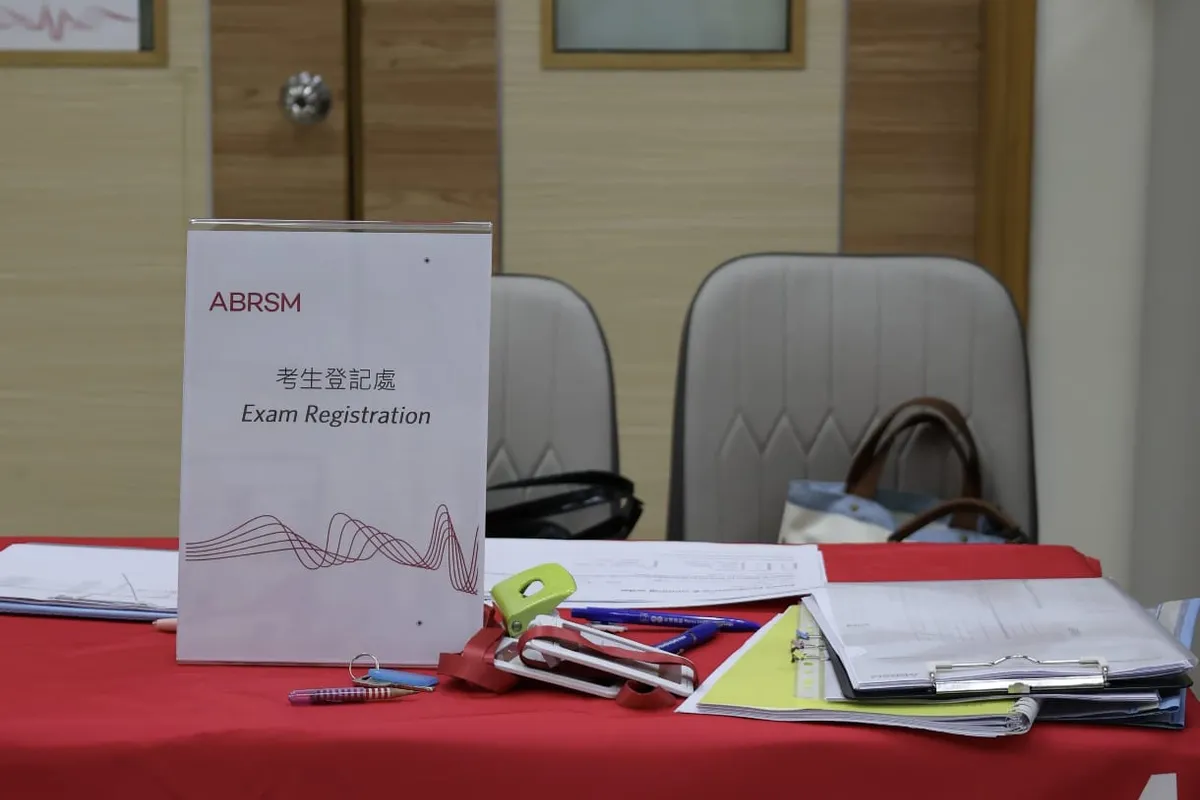
For many students and parents, ABRSM exam day is often the most nerve-racking day of all. No matter how well the pieces are prepared, facing an unfamiliar venue, an unfamiliar piano and an examiner can bring unease. In truth, understanding the actual procedure of exam day beforehand can dissolve much of that anxiety. How early should you arrive? Is there time and space to warm up? Can you decide which part to do first? Will the examiner signal you to stop partway? Drawing on official ABRSM guidance, this article sets out the procedure and key preparations for exam day, to help students and parents face the exam with a clearer, calmer mindset.
Arriving at the Venue: Early Arrival and Check-In
From practical experience at Hong Kong exam venues, it is best for a candidate to arrive at least about fifteen minutes early, to have ample time to settle and prepare. On arrival, a steward usually greets candidates and shows them to a waiting area, and asks them to fill in a programme form listing the pieces they will play that day.
Arriving early is not just about check-in formalities — it also gives the candidate time to adjust to the surroundings and settle their nerves. Rushing to the venue tends to add another layer to existing nerves; leaving ample time is itself a first step toward a steady mindset.
Warming Up and the Order of the Exam
It is worth noting that Hong Kong ABRSM venues generally do not have a separate warm-up room, only a waiting area; at some venues held in a piano shop, parents may be able to book a practice room separately beforehand, but rather than cramming at the last minute, it is better to enter with a calm mind. Once in the exam room, a candidate may play a few notes on the piano to get a feel for its touch and tone — examiners are happy to see this, so there is no need to worry.
As for the order, candidates usually play their pieces first, but may choose to begin with other sections such as scales, sight-reading or aural. If there is a preference, it is best to let the steward know beforehand so it can be arranged. If your child feels lost during preparation, or would like to review their playing and mindset before the exam, a one-to-one piano consultation can help review where their preparation stands.
What Happens During the Exam?
Once the exam begins, the candidate works through the pieces and each section in order. Pauses between pieces are normal — the examiner needs time to write comments and marks, and will indicate when to begin the next piece, so there is no need to be alarmed by a brief silence.
Sometimes, having heard enough, the examiner may signal to move on to the next section; this is a normal part of the exam and does not mean the performance was poor. Throughout, if nerves rise, taking a deep breath and adjusting the posture and hand shape before starting each piece helps the candidate return to a steady state.
What Parents Can Prepare
A parent’s role on exam day is chiefly to provide steady support. Beforehand, you can help the child leave ample time to arrive, bring all the required scores and documents, and keep the atmosphere as relaxed as possible, avoiding added pressure in the final stretch.
It is worth remembering that exam performance is shaped by many factors, including nerves and state on the day; a single result cannot fully represent a child’s musical ability. Whatever the outcome, the experience of exam day is itself a valuable step of growth on a child’s musical path.
Further Reading
On the Difference Between Piano Exams and Piano Performance Competitions
The Complete ABRSM Grade 8 Piano Guide: New Syllabus Explained
Beyond “Passing the Exam”: Why I Care More That Students Can Truly Play
Frequently Asked Questions
How early should we arrive on exam day?
From practical experience at Hong Kong exam venues, it is best to arrive at least about fifteen minutes early, so check-in and the programme form can be completed unhurried, and the candidate has time to adjust to the surroundings and settle their nerves.
Is there anywhere to warm up at the venue?
Hong Kong ABRSM venues generally have only a waiting area, not a separate warm-up room; at some venues held in a piano shop, parents may be able to book a practice room separately. But rather than relying on a last-minute warm-up, thorough day-to-day preparation matters more. Once in the exam room, the candidate can play a few notes to get used to the piano.
Can we choose which piece to play first?
Yes. Candidates usually play their pieces first, but may choose to begin with other sections (such as scales, sight-reading or aural). If there is a preference, it is best to let the steward know beforehand so it can be arranged.
If the examiner signals to stop, does it mean my child played badly?
Not necessarily. Having heard enough, the examiner may signal to move on to the next section; this is a normal part of the exam procedure and does not mean the performance was poor.
My child gets stage fright easily — what can we do?
Some nerves are very common. Beyond thorough preparation, simulating exam conditions in everyday practice helps the child become familiar with the procedure; on the day, a deep breath and an adjusted posture before each piece help them return to a steady state. Managing mindset matters as much as technical preparation.
Ms. Kannaz Kwok
30+ years of piano teaching experience. Holder of internationally recognised qualifications from the Royal Academy of Music and Trinity Laban Conservatoire.