
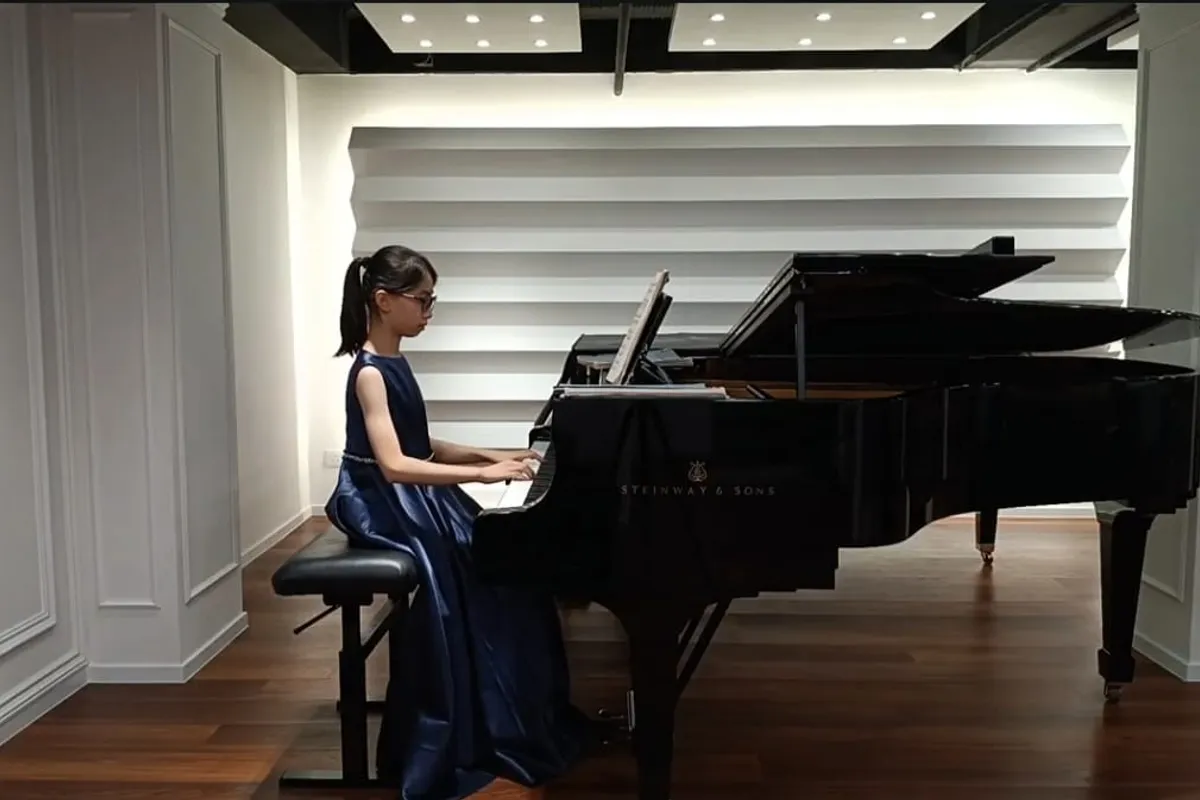
Grade 8 isn't just "two more grades" — it's the highest of the ABRSM Practical Grades, and the gateway into performance and teaching diplomas such as ARSM, DipABRSM and Trinity College London's ATCL. In fact, many students move on from Grade 8 to the Trinity College London ATCL performance diploma.
Every year in Hong Kong, large numbers of students push for ABRSM Grade 8, yet far fewer parents and students truly understand what Grade 8 is testing and assessing. Based on the official 2027 & 2028 syllabus, this article pulls together everything from entry requirements and exam components to the new set repertoire, selection logic and how to plan the preparation.
1. The Entry Requirement You Must Know Before Booking
Since 2018, ABRSM has required that before sitting the Practical or Performance exam for Grades 6, 7 and 8, candidates must first have passed Grade 5 (or above) Music Theory:
• ABRSM Grade 5 Music Theory
This is a condition to verify before booking — many parents only discover at the registration stage that their child hasn't sat Grade 5 Theory, throwing the whole preparation rhythm off. It's best to start preparing Grade 5 Theory in parallel once a student reaches roughly Grade 5 playing level.
2. The Two Grade 8 Exam Formats
Since 2020, ABRSM has run two exam formats in parallel. Their components differ entirely, and so does the preparation strategy:
• Practical Grade: a live, in-person exam comprising 3 pieces (one each from Lists A, B and C), scales and arpeggios, sight-reading and aural tests.
• Performance Grade: submitted by video, presenting 4 pieces (3 from Lists A, B and C plus 1 own-choice piece) as a continuous programme, with an additional mark for the overall performance.
Both are equally recognised and both count for UCAS points (within the UK admissions system). The Practical Grade trains live responsiveness in front of an examiner; the Performance Grade is closer to a real performance routine and suits students who already enjoy being on stage. This is the first decision to settle in a consultation.
3. The Practical Grade 8 Scoring Structure (out of 150)
The exam is marked out of 150, with three thresholds: Pass at 100, Merit at 120, and Distinction at 130.
The four components carry the following weighting:
• Piece 1 (List A): 30 marks
• Piece 2 (List B): 30 marks
• Piece 3 (List C): 30 marks
• Scales and arpeggios: 21 marks
• Sight-reading: 21 marks
• Aural tests: 18 marks
Per-piece banding: Distinction is 27–30 (highly accurate pitch and rhythm, fluent and flexible, expressive in colour and detail, vivid and confident in style); Merit is 24–26 (largely accurate pitch and rhythm, steady tempo, good tone control, clearly shaped phrasing); Pass is 20–23 (basically correct, with an acceptable level of timing, tone and expression).
One key realisation: every extra 3 marks crosses a band. In other words, the gap from Pass to Merit often comes down to just "a few technical details" — a point this guide returns to below.
4. The 2027 & 2028 Grade 8 Set Repertoire
The ABRSM 2027 & 2028 piano syllabus was officially published in 2026 and takes effect from 1 January 2027. The 9 set pieces for Grade 8 are:
List A (tightly structured, precise musical thinking):
• A1 Bach — Allegro: first movement from Italian Concerto BWV 971
• A2 Beethoven — Rondo: 3rd movement from Sonata in C minor, 'Pathétique', Op. 13
• A3 Ravel — Fugue (No. 2 from Le tombeau de Couperin)
List B (lyricism and expression):
• B1 Frank Bridge — Rosemary (No. 2 from Three Sketches, H. 68)
• B2 Chopin — Nocturne in E minor, Op. 72 No. 1
• B3 Zhu Jian'er — An Offering of Intimacy (No. 1 from Two Preludes, Op. 4)
List C (rich in colour and technique):
• C1 Waltz Caprice
• C2 Footprints in the Sand (from Dreamland)
• C3 Winterley
The general view in the field: the overall difficulty of the 2027–2028 syllabus is, at Grade 8, among the most demanding in recent years, with a rich diversity of styles — from classics by Bach, Beethoven, Chopin and Ravel to a work by the contemporary Chinese composer Zhu Jian'er. The repertoire's horizon has clearly broadened.
The official Piano Learning Hub provides demonstration videos, musical analysis, practice activities and background notes for each piece — a free resource you shouldn't miss when preparing for Grade 8.
5. Selection Logic: Character × Ability × Diversity of Colour
Choosing repertoire is not just "picking a piece that sounds nice." When I select repertoire for a student, I align three dimensions at once:
1. The student's own traits. Character (outgoing? introspective? emotionally rich? analytical?), musical ability (solid technique but weak expression? or rich in feeling but lacking clarity of articulation?), and the practice conditions they can realistically commit to. Every student is different; align these factors and the right pieces tend to surface naturally — rather than forcing a piece onto the student.
2. The three pieces must represent three different styles. When a student has to command three different musical languages at once, their technical versatility and interpretive range are stretched fully — a growth far deeper than simply "passing the exam."
3. Once chosen, the repertoire must respect the student's actual practice conditions. A student with limited practice time isn't suited to starting out on a full set of longer pieces (such as a complete Beethoven sonata movement). Every student is different; repertoire and practice planning go together and should be decided according to the actual situation.
6. The Five Layers of Musical Analysis
For every exam piece, I take the student through the following five layers — this is the core work that lifts a performance from Pass to Merit or Distinction:
1. Formal structure: How many sections does the piece have? What is each section's role?
2. Harmonic language: How does the composer use harmony to drive emotion? Main key, points of modulation, sequential writing.
3. Rhythmic features: Are there distinctive rhythmic patterns? Where is control easily lost? How to handle rhythm across bar lines.
4. Shifts in colour: Which bar is the key moment of "changing colour"? What touch, pedalling and dynamic layering should present it?
5. Technical challenges: Which passages need to be isolated and drilled? With what method?
Turn these five layers into a single "map of musical analysis," and the student is no longer walking a mountain path with their eyes closed.
7. Preparing Scales, Sight-Reading and Aural
Grade 8's scales and arpeggios, sight-reading and aural tests (60 marks combined) make up 40% of the total. Many parents treat them as "add-ons" and overlook them — but in fact these three are often the dividing line between Merit and Distinction.
Scales and arpeggios (21 marks) are the largest single block at Grade 8: all major and minor keys (4 octaves, hands together; minors in natural, harmonic and melodic forms), chromatic scales (4 octaves, hands together, a minor third apart), chromatic scales in minor thirds (2 octaves, hands separately), the whole-tone scale (starting on E), arpeggios (including root position and first and second inversions, 4 octaves), dominant and diminished seventh arpeggios (4 octaves), and scales in sixths (D, F, A♭ and B major over 4 octaves legato; C major over 2 octaves staccato, hands separately). In the exam, all must be played from memory and without pedal.
Sight-reading (21 marks) is roughly the length and difficulty of a complete short piece at around Grade 5 level, including modulation, compound time, chromatic clusters and pedal markings. The examiner allows 30 seconds of preparation — what to look at in those 30 seconds, and in what order, is the heart of sight-reading training.
Aural tests (18 marks) include singing the lowest note of a chord, identifying cadences, echoing rhythms and recognising features of a piece. Aural ability must be built over the long term and can't be crammed, so it's best to start systematic training early — exactly when depends on the student's level and situation.
8. A Framework for Grade 8 Preparation: Measured by Progress, Not Months
Many guides set a standard preparation period of "8 to 12 months," but students differ enormously in their grounding, daily practice time and rate of absorption, so binding progress to a fixed number of months isn't really sound. What truly decides the outcome is a step-by-step, highly individualised teaching plan and the teacher's professional ability to steer it — not simply time spent. The framework below is measured by learning progress, not by months:
1. Orientation (confirming the foundations)
• A full assessment of the student's current playing, sight-reading and aural sensitivity
• Checking the hard entry requirement: Grade 5 Theory must already be passed
• Explaining the difference between the two exam modes — Practical (a standard live assessment) and Performance (a recital-style assessment) — and settling the format together, in light of the student's character and their strengths and weaknesses
• Pinning down the current official syllabus repertoire and setting the overall direction
2. Matching and selecting repertoire (selection planning)
• Trial-playing a wide range of candidate pieces, comparing them across style, technical difficulty and performance load
• Choosing 3 main pieces that are stylistically varied and play to the student's strengths, based on their hand shape, performing temperament and strong and weak techniques
• Tailoring a stable, personal practice arrangement around the student's academic pressures and available practice slots, balancing workload with rest
3. Detailed unpacking and refining (consolidating the fundamentals)
• Unpacking each of the three pieces in depth: a complete analysis of harmony, rhythm, phrasing and period style
• Layered practice: breaking the whole into sections, phrases and single technical difficulties, mastering each slowly, and correcting fingering, weight and unwanted noise one by one
• Running the supporting training in parallel: scales, sight-reading and aural progress steadily, so the fundamentals aren't left behind
• A key pitfall: at this stage, don't rush to raise the tempo of the whole piece — pushing speed too early tends to cause loose rhythm, rough tone and stiff hand muscles, the most common source of lost marks in preparation
4. Integrating the whole piece artistically (shaping it into form)
• Only once the sections are fully secure, join the piece into a continuous whole, smoothing the transitions of breathing and emotional shifts between sections
• Refining the musical layers: dynamic shape, judgement in pedalling, contrast of colour — guiding the student to invest emotionally in the music
• Keeping a regular frequency of mock sight-reading, to build the on-the-spot reading instinct
5. All-round exam readiness (finding and fixing gaps)
• Regular full mock exams and recording reviews, to bring hidden flaws clearly into view
• Running exam-psychology support in parallel, to ease stage nerves
• Finding and reinforcing gaps in the two foundational blocks — scales and aural — to secure the scoring essentials
6. Final on-the-spot fine-tuning (calibrating the state)
• Finely polishing tempo, dynamic detail, and breathing and pauses
• Easing the practice load appropriately before the exam, to avoid wearing out the hands through fatigue
• Building a personal pre-stage mental routine to steady performance on the day
Key answers for parents and students:
• Why not plan by a fixed number of months? A strong student with ample daily practice time can have the whole cycle shortened; a student with weaker grounding and limited practice time will have the teacher slow the unpacking and lengthen the refining stage. Forcing a fixed month count onto them only produces one of two bad outcomes — rushing them like "pulling up the seedlings," or just going through the motions.
• The teacher's planning ability is what decides the outcome. An experienced teacher can judge precisely how much a student has absorbed at each step: when to start joining the whole piece, when it's right to raise the tempo, which areas need extra drilling, and when to step in with psychological support. Relying on a student to practise blindly and at length alone tends to accumulate technical gaps, stiff musical expression and stage fright; only a mature, individualised plan can score reliably and efficiently.
• Practice quality matters far more than practice length. In the same span of practice time, practice with clear goals and a plan is far more efficient than playing from top to bottom with no focus; the teacher's plan is exactly what removes wasted practice, so that every time the student sits at the piano there's a clear target to overcome.
9. Three Key Gaps Between Pass and Merit/Distinction
By ABRSM's published marking criteria, the real difference between Pass and Merit/Distinction concentrates in three areas:
1. Tonal control: at Pass it's "acceptable," at Merit it's "controlled," at Distinction it's "full of colour."
2. Musical shaping: at Pass it's "presented," at Merit it's "intended," at Distinction it's "expressive."
3. Overall commitment and conveyance of style: the hardest to quantify, yet the most decisive for an examiner's impression.
None of these three is reached by simply putting in more practice hours — they depend on musical analysis, listening training and the right practice method.
Consultation: An Objective Assessment for Your Grade 8 Preparation
If you're facing any of the following: preparing for Grade 8 but unsure about the syllabus or how to choose between Performance and Practical; already preparing, but the results aren't matching the effort invested; retaking, and wanting to avoid going down the same unproductive path again; or, as a teacher, wanting more complete repertoire selection and planning for your students —
you're welcome to book a one-on-one professional piano consultation. A single session may help you see clearly how to navigate the road ahead.
Further Reading
The Teaching Logic Behind ABRSM Grade 8 Repertoire Selection
Two Months in the US Over Summer — How Does a Student Avoid Slipping Back?
Two Years of ATCL Preparation, Still No Pass — When Effort Isn't the Same as Method
Frequently Asked Questions
Should I choose the 2025-26 or the 2027-28 syllabus?
From January 2027, all exams use the 2027 & 2028 syllabus. There is an "overlap period" between 2025-26 and 2027-28, so students already preparing should confirm which syllabus the date of their upcoming exam falls under.
Which is easier to pass, Practical or Performance Grade?
ABRSM does not publish a comparison of pass rates. The Performance Grade's overall-performance mark may favour stage-confident students, but playing four pieces continuously demands more stamina and concentration. Which suits a student depends on their individual traits.
Can I sit Grade 8 without passing Grade 5 Theory?
No. Before sitting the Practical or Performance exam for Grades 6 to 8, you must already have passed Grade 5 Music Theory.
How long should I practise each day at Grade 8?
There's no single number that fits everyone. Each student's level, repertoire difficulty and daily rhythm differ, so practice time should be set according to the actual situation. More important than how long you practise is whether the practice has direction and method.
When choosing pieces, should I pick what I love most or what my teacher suggests?
Ideally, the intersection of the two. Picking purely what you "love most" may miss the syllabus's intent of diverse training; following only the teacher's suggestion may leave you short of motivation. This tension should be aligned at the consultation stage.
Ms. Kannaz Kwok
30+ years of piano teaching experience. Holder of internationally recognised qualifications from the Royal Academy of Music and Trinity Laban Conservatoire.