
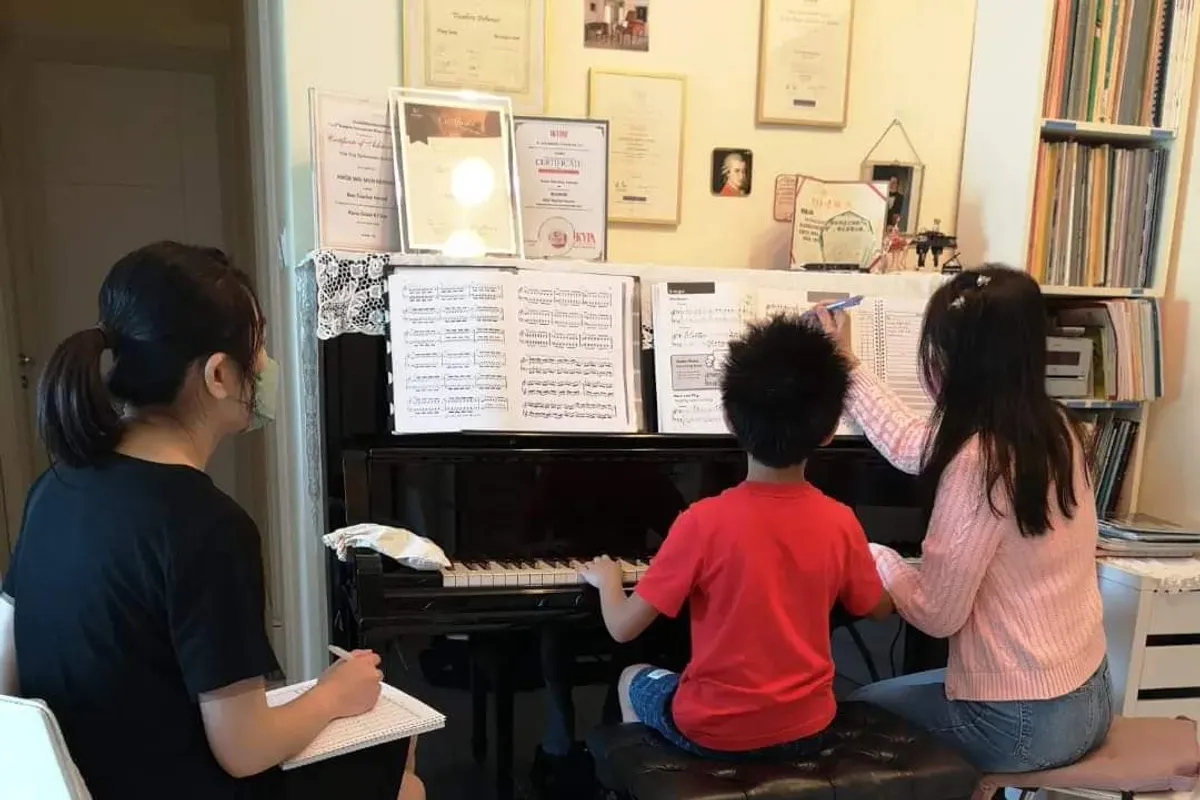
A teaching system built over ten years may need recalibrating in front of a four-year-old.
Background
A piano teacher with ten years of experience came for a teacher consultation. She admitted that every time she takes on a four-year-old, she feels back at zero. She brought four questions — each one a genuine pain point from the front line of teaching.
Question One: How Do I Communicate Practice Rhythm With Parents?
A four-year-old's capacity for self-directed learning is still developing, and a parent's role in the process is to support, not to replace the teacher. My suggestions:
• Redefine the parent's role: build the environment (fixed time slot, quiet space, short and frequent sessions), not carry the teaching
• Keep instructions concrete: not "practise Hanon No.1", but "left hand walks C-D-E-F-G up and back three times, counting four beats each"
• Be understanding about what parents can do: the teacher is the main driver of the child's learning
Question Two: How Do I Assess and Handle Muscle Development?
Four-year-olds vary widely in joint stability and hand-muscle strength. In assessment I observe: finger independence, wrist stability, whether the first joint collapses, thumb freedom, and dynamic control.
If joints aren't stable and the hand muscles are still soft, it isn't the time to rush into lots of notes: start with off-keyboard finger-strengthening games (squeezing clay, picking up beans) and slow single notes, aiming for every note pressed with stability rather than progress.
Question Three: How Do I Build a Good Hand Shape?
A four-year-old may not grasp an abstract instruction like "keep your wrist level" — use guidance through images:
• Holding a little apple (builds the arch)
• The wrist is a little bridge (stays level)
• Fingertips are a ballerina's toes (standing firm, never collapsing)
Each hand-shape exercise should show its effect within about 30 seconds, then switch to the next.
Question Four: How Do I Help a Restless Child Focus?
A child this age struggles to sit still for thirty minutes. The answer is to redesign the format of the lesson:
• Split 30 minutes into six 5-minute activities: music game / rhythm clapping / single notes / listening games / a short story with music / free playing
• Turn commands into invitations: "would you like to try this?" rather than "now play this"
• Build a "move around" segment into the middle — integrate the running and jumping into the lesson
• End with a teaser: "Next time we're going to play a brand-new game."
In Closing
"I finally have a framework I can reuse across different students," the teacher said as she left. The greatest value of a consultation isn't handing over an answer — it's handing over a set of thinking tools.
If you are facing teaching bottlenecks of your own, you're welcome to work through them with a teacher consultation or my piano teacher development programme.
Frequently Asked Questions
Is four too young to start piano?
The point isn't the age but whether the lesson matches the child's attention span and muscle development. Designed well — short segments, games, image-based guidance, hand shape before progress — four can be a fine start; if the hands are still soft and joints unstable, begin with finger-strengthening activities and slow single notes.
Do teachers need consultations too?
Working piano teachers are often among those who benefit most — one conversation can distil years of teaching experience, help unpack a specific case, and produce a reusable framework for thinking through problems.
Does a four-year-old need to practise Hanon?
At this stage the focus is stabilising the fingers, relaxing the wrist and keeping interest alive — not a specific method or set pace. Game-based single-note and hand-shape work gradually builds a foundation that lasts a lifetime.
Ms. Kannaz Kwok
30+ years of piano teaching experience. Holder of internationally recognised qualifications from the Royal Academy of Music and Trinity Laban Conservatoire.