
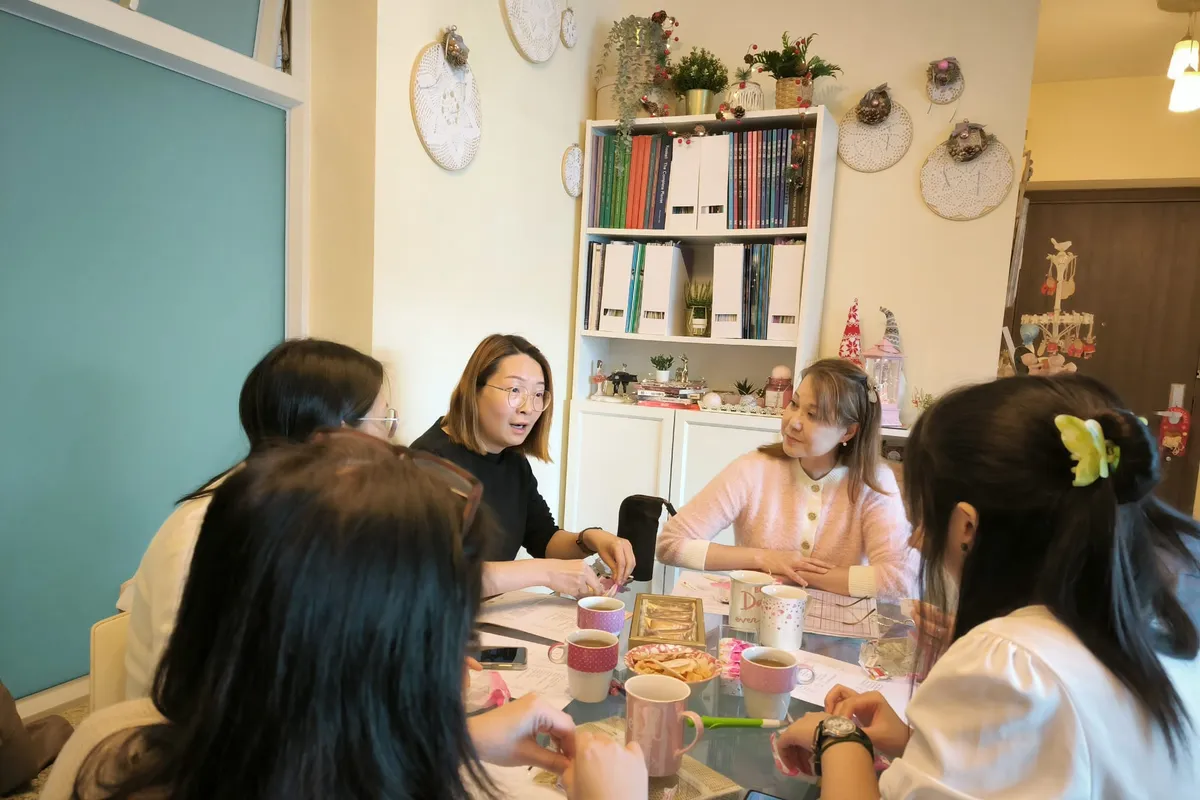
"Ms. Kwok, I've been teaching piano for ten years, but every time I take on a four-year-old, I feel like I'm back to zero. There are four things I want to straighten out — can you help me?"
The teacher who walked into my consultation room that day was one of the most humble and serious colleagues I have met. Ten years of experience, and still willing to admit "with four-year-olds, I fall short" — that in itself is the starting point of a good teacher. Each of her four questions was a genuine pain point from the front line of teaching.
Why "Ten Years of Teaching" and "Teaching a Four-Year-Old" Are Two Different Things
Many experienced teachers discover this: primary students, secondary students, adults — all of them can be handled with a mature teaching system. But age four is a completely different world.
A four-year-old: is still rapidly developing language comprehension — they don't necessarily understand everything you say; has muscle coordination that varies hugely from child to child; usually sustains attention for only 10–15 minutes; swings emotionally — loving you one second, rejecting you the next; and is not built for following instructions — they need to be guided and attracted, not commanded.
The "command-style" teaching accumulated over ten years is almost useless at this age. That is why experienced teachers feel confused — not because their ability is lacking, but because the entire framework needs a reset.
Question One — How Do I Communicate With Parents About Practice Time and Rhythm?
Her first question is the shared difficulty of every four-year-old case: parents want to help, but what they can do is limited. A four-year-old has no self-learning ability yet; when the teacher isn't there, the parent is asked to "stand in for the teacher" — but they aren't teachers. How do you resolve that contradiction? My advice has three layers.
Layer one — redefine the parent's role. The parent is not a substitute teacher; the parent builds the practice environment: a fixed daily practice slot (same time every day, building habit), short and frequent sessions (5–10 minutes, two or three times a day — far more effective than a single 30-minute block), a quiet space, and only the tasks the teacher assigned (no improvised extras).
Layer two — translate the teacher's instructions into a list parents can actually execute. Don't write "have him practise Hanon No. 1." Write "sit with him while his left hand walks C-D-E-F-G up and back three times, counting four beats each time." When the instructions are concrete and simple enough, parents don't get stuck and don't drift off course.
Layer three — accept that what parents can do is exactly this much. The teacher needs to design a course where the child still progresses even if the parents only manage basic cooperation. This is the key mindset for teaching four-year-olds: the parent is not the teacher's stand-in — the teacher is the main engine of the child's learning.
Question Two — Muscle Development Varies Hugely at Four. How Do I Assess and Respond?
"Some four-year-olds already have fairly stable joints; others still have very soft hand muscles. How do I judge? And what do I do about it?" — her question was precise, and it touches basic knowledge that too many piano courses ignore.
In the first lesson I assess these points:
• Finger independence — when one finger presses a key gently, do the others sink with it?
• Wrist stability — can the wrist stay level with the forearm?
• The first joint — does it collapse when pressing down?
• Thumb freedom — can the thumb move independently?
• Dynamic control — can the child play softly, then loudly, then softly again?
If the joints are not yet stable and the hand muscles are still soft — do not rush into playing lots of notes. Start with off-keyboard finger-strengthening games (squeezing clay, picking up beans, cutting paper) and slow single-note practice — one note, one finger, slowly. Don't chase repertoire progress; chase "every note pressed with stability." And communicate with parents in good time: "At this stage the priority isn't progress — it's building a hand shape that will serve a lifetime of playing."
Question Three — How Do I Build a Good Hand Shape for a Four-Year-Old?
Behind this question is an entire book's worth of material. Here is the framework — three stages of hand-shape training at age four.
Stage one — the natural hand. Don't rush to teach "arched" or "rounded." Let the child first place their most natural hand on the keys, and observe whether the natural shape has problems (collapsing fingers, sinking wrist).
Stage two — guidance through images. A four-year-old cannot process "please keep your wrist stable" — but they can process "imagine you're holding a little apple in your hand." Images I often use: holding a little apple (builds the arch), the wrist is a little bridge (stays level), fingertips are a ballerina's toes (standing firm, never collapsing).
Stage three — practice through games. A four-year-old's attention is short — every hand-shape exercise should show its effect within 30 seconds, then switch immediately to the next game. For example: fingers "walking" across the keys; "clap three times, rest one, clap three more" follow-the-teacher; or "freeze your hands the moment you hear me say stop."
Question Four — They Jump and Run Non-Stop. How Do I Get Them to Focus?
"A four-year-old still wants to jump, run and play. Asking them to sit through a 30-minute lesson with full attention is simply unreasonable." Correct. At this age, they genuinely cannot do it. But that doesn't mean they can't be taught — it means the format of the lesson has to be completely redesigned.
First, split 30 minutes into six 5-minute blocks. A new activity every five minutes: a music game, rhythm clapping, single notes at the piano, listening and identifying sounds, a short story with music, free playing. Never spend more than five minutes on the same thing — that matches a four-year-old's attention curve exactly.
Second, turn commands into invitations. Not "now play this" but "would you like to try this?" At four, a sense of autonomy is the key to participation.
Third, give the body an outlet. Build a "move around" segment into the middle of the lesson — clapping, stomping, spinning, jumping to the music. Integrate the jumping and running into the lesson instead of suppressing it.
Fourth, end with anticipation. Leave a little teaser at the end of every lesson: "Next time we're going to play a brand-new game." The child leaves carrying that anticipation — and arrives at the next lesson with more motivation.
What Did This Consultation Leave Behind?
"I've taught for ten years, but so much of it ran on experience rather than on a system. After today, I finally have a framework I can reuse across different students." That is what she told me as she left.
And that is the greatest value of a consultation — not handing over an answer, but handing over a set of thinking tools. Whatever kind of four-year-old she meets in the future, she can break the problem down herself.
To Every Piano Teacher Facing Young Children
If you have ever faced this: rich teaching experience, yet still getting stuck with young children; high parental expectations while the child's abilities are only beginning to emerge; not knowing whether to hold the teaching schedule or wait for the child to grow; wanting professional development but finding no course aimed at early-childhood piano teaching — you are welcome to book a teacher consultation. Bring your most difficult case, and we will break it down together.
You may also want to look at my professional development programme for piano teachers — built around the ABRSM teaching diplomas, systematically strengthening the professional teaching skills of working piano teachers.
Teaching four-year-olds is, in fact, where my four anchors show most clearly: genuinely teach each student as an individual — every four-year-old is different, and no standard procedure fits them all; build a systematic learning model — even a four-year-old's course needs structure and progression; cultivate self-learning and thinking — at this age, autonomy is the core of motivation; face exams and performance rationally — a four-year-old doesn't need exams; they need solid foundations and happy memories.
Frequently Asked Questions
Ms. Kannaz Kwok
Thirty years of piano teaching experience. Holder of internationally recognised qualifications from the Royal Academy of Music and Trinity Laban Conservatoire.