
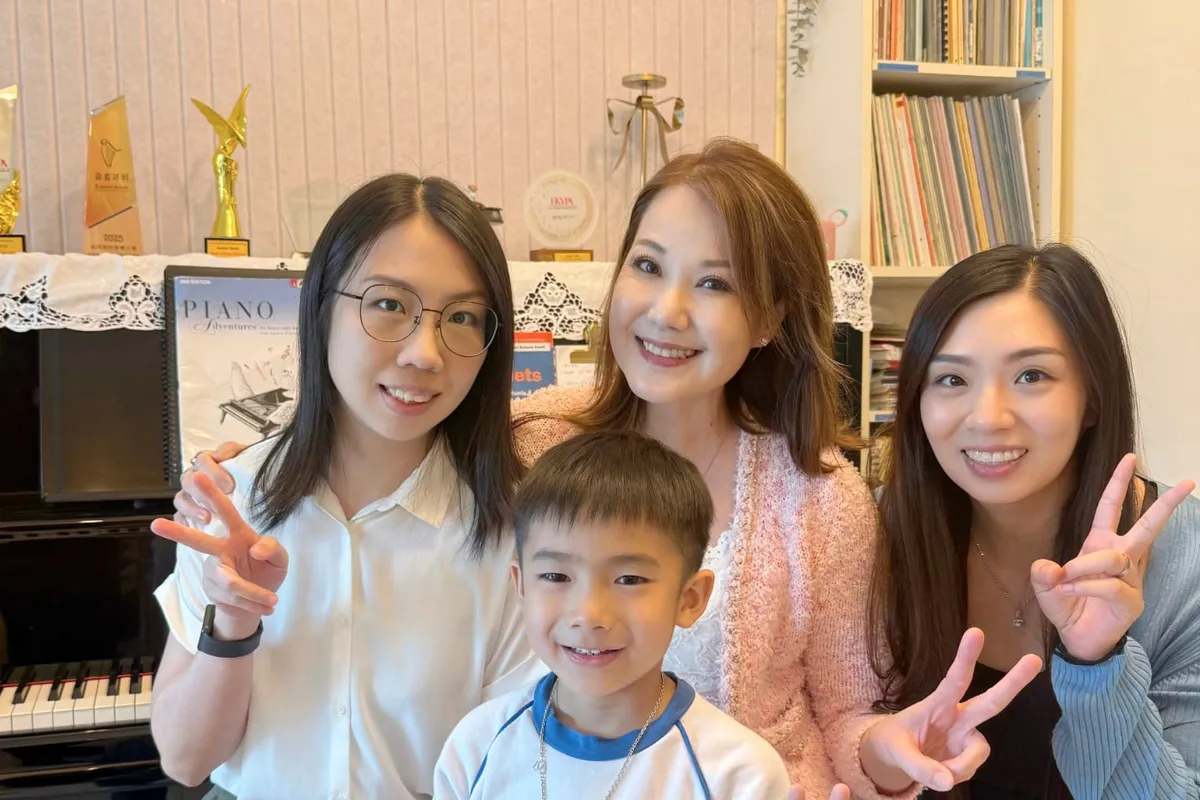
"I play piano myself, and I thought learning it would help my son's focus and coordination. But we've changed teachers twice, and he still can't get going." Those were the first words from a mother bringing her Primary 1 son to me.
Today I want to write down this student's full journey — from "stalled through two teachers" to "teaching himself new pieces and telling his parents 'you don't need to help me'" — not to prove anything, but so that more parents, students and fellow teachers facing similar predicaments can see another possibility.
The Starting Point: The Problem Was Never "the Child Isn't Trying"
This student started piano in K3; by Primary 1 he had been learning for nearly two years. His mother plays, can accompany practice, reads music; the family had already tried two teachers — on paper, conditions better than most.
And yet: progress stalled, interest fading, the mother more exhausted with every practice session, the child more resistant with every piece. She brought him for a one-on-one consultation with one simple request: "Please find out why he can't learn."
In my thirty-plus years of teaching, "can't find the direction" is perhaps the most common — and least visible — core problem in music learning. And the value of a consultation is not to hand out answers, but to restore the root cause first.
What Did the First Consultation Find?
In one short session I noticed two things both previous teachers had missed: First — this child doesn't dislike music. He actually loves it. Second — his personality: strongly self-directed, wants to call the shots, hates following other people's instructions.
Put those two together and everything is explained: the teacher says "play it like me" — he resists; his mother says "you should practise it this way" — he goes through the motions; the textbook demands step-by-step compliance — he loses interest.
The problem was never his ability. It was that he had been placed in the position of being commanded, while his personality needed him to be the one commanding himself. Diagnose that, and the method follows.
Module One — Rhythm: Hand the Choice Back to the Child
I redesigned his course around three core modules — rhythm, sight-reading, listening — and the design heart of every module was to make him the protagonist.
The old rhythm practice: teacher demonstrates once, child imitates. For a child who wants to call the shots, that model switches him off from the first second.
The new approach: I take the same rhythmic pattern and design several ways to play it — clapping, stomping, rhythm cards, maracas — and let him choose which one to practise with today. The teacher only supplies the pool of methods; the real choice belongs to the child. The effect was immediate: he began looking forward to rhythm practice, because it was "his time."
Module Two — Sight-Reading: Let Him "Compose" His Own Pieces
His reading ability was actually fine — but he hated playing from the score. Same root cause: he didn't want to be commanded by the notes.
The new approach: using magnetic boards, game cards and staff games, I turned notes into elements he could freely combine — letting him string notes together into a little piece of his own, and then practise that.
This is the key psychological flip — when what he practises is his own work rather than someone else's writing, practice transforms from "executing a task" into "presenting a work." From then on, the motivation to practise no longer needs external pushing.
Module Three — Listening: Turn "Spot the Mistake" Into a Game
Listening was already his strength — but again, he "doesn't like listening to others," which means the traditional demonstrate-and-imitate model was useless for him.
The new approach: first, listen together to several correct rhythm and music demonstrations to build an accurate internal reference. Then — and this is the key — the teacher deliberately plays it wrong, and asks him to find the mistake.
From "being instructed" to "pointing out someone else's errors", he snapped into focus instantly. And this style of training builds precise pulse and sharp aural discrimination just as well — only by a different path.
Above the Three Modules: Make Him the Director of the Piece
Once rhythm, sight-reading and listening were established, I poured those abilities into the learning of every new piece. Since he is creative and loves to be in charge — for every new piece, I first play it through for him once, then tell him: "From now on, you are the director of this piece."
Then I guide his thinking: who is the character of this phrase — sad, mischievous, gentle? And the next phrase — the same character, or a new one? What story should the whole piece tell?
The music stops being "a collection of notes" and becomes "the story he wants to tell." Teaching a child to tell stories is fun for them — and when practice becomes "I want to play my story out loud," he sits down at the piano by himself.
The Turning Point: When He Started Saying "You Don't Need to Help Me"
Teaching effectiveness is never measured by "how many lessons attended" but by whether the child's learning state undergoes a qualitative change. Over this period, three things happened: he began picking up new pieces by himself, independently completing the sight-reading, rhythm and listening stages; he began deciding the interpretive character of each phrase himself; and he began teaching himself complete new pieces.
And the most moving moment: when his mother sat down beside the piano as usual, ready to supervise practice — he looked up and said quietly: "You don't need to help me."
For a mother who had accompanied practice to the point of exhaustion, those words outweighed any exam result. Because they meant the child now owned the ability he gets to keep — the ability to learn by himself.
Reflections for Parents, Students and Fellow Teachers
This case is not out to prove that magnetic boards beat traditional materials, or that mistake-finding games beat demonstrate-and-imitate. No method is universal. The real key is —
For parents: when a child has learned for years without progress, pause before reaching for "change the teacher." Before switching, run one complete learning consultation and find the true root cause. Sometimes the problem is not ability, not effort, but that this child's personality is incompatible with the current teaching model.
For students: if you too are someone who "hates following instructions" — that is not a flaw. It only means you need a teacher who collaborates with you rather than merely commanding you. With the right method, your personality becomes your greatest advantage.
For working piano teachers: my conviction across thirty-plus years of teaching has always been — certificates are only the ticket in; what truly decides how far a child's musical road goes is the teacher's teaching ability. And the core of teaching ability is precisely "teaching each student as an individual" — not a slogan, but a craft of constant deconstruction and rebuilding.
The Four Anchors of My Teaching
Behind this case stand the four core principles I have held for years: genuinely teach each student as an individual — understand the personality, ability and rhythm first, then design the dedicated course; build a systematic learning model — from simple to deep, every module with a clear role; cultivate self-learning and thinking — the final goal of teaching is the day a child can say "I can do it myself"; face exams and performance rationally — solid fundamentals first, with exams used only as objective verification.
If you are a parent who sees years of lessons without visible progress and isn't sure where the problem lies; a student who practises hard but can't break the ceiling; or a working teacher who can't find the entry point with certain personalities — you are welcome to book a one-on-one professional music consultation. One session may not solve everything — but it can show you clearly where the problem actually is.
Frequently Asked Questions
Ms. Kannaz Kwok
Thirty years of piano teaching experience. Holder of internationally recognised qualifications from the Royal Academy of Music and Trinity Laban Conservatoire.