
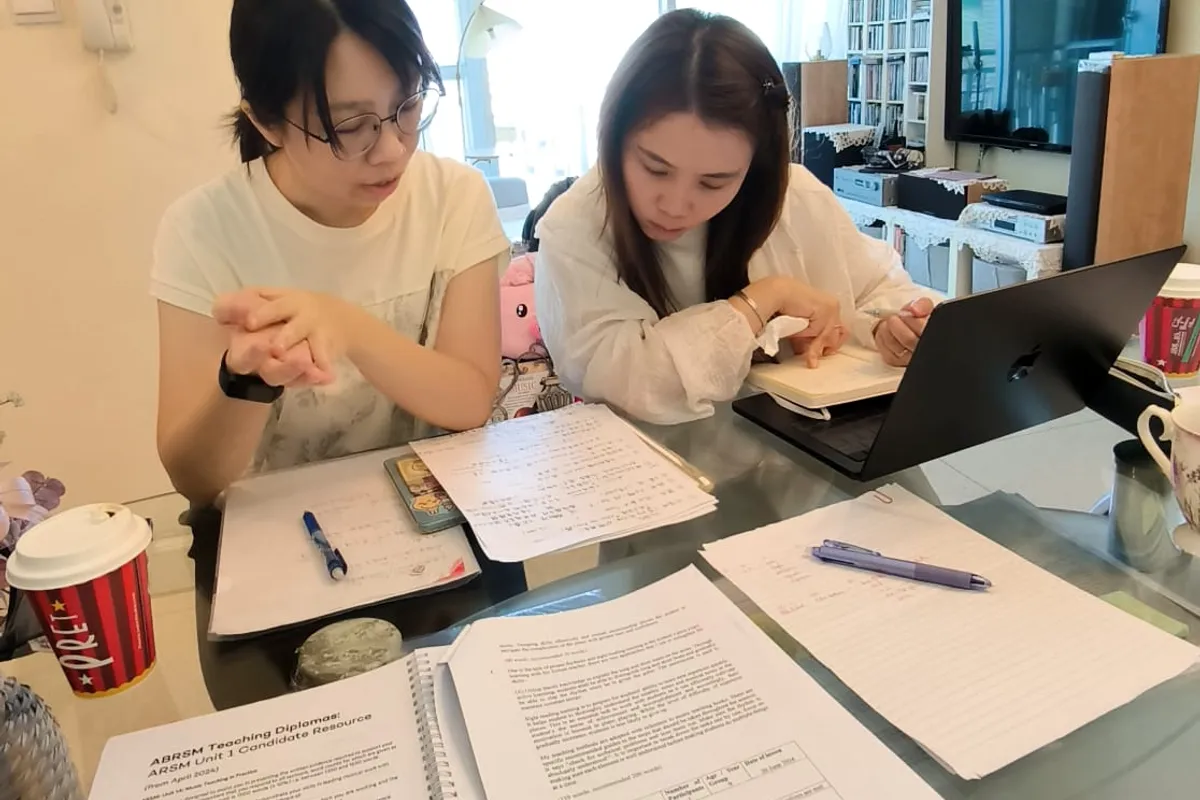
"Ms. Kwok, I came all the way from Tuen Mun to find you in Tai Wai. I've spent two years preparing for the ATCL performance diploma, and I still can't pass. My own teacher tells me it's because I don't practise enough — but I really have been working hard. Where is the problem?"
When this student sat down in front of me, two emotions were written on his face — exhaustion, and a last thread of hope that refused to give up. And once I understood his background, I knew immediately: he wasn't short of practice. His practice was pointing in the wrong direction.
The Double Identity of a Part-Time Piano Teacher
There was an important signal in this student's background — he is himself a part-time piano teacher. What does that mean? He understands music. He knows the basic principles of practising. He has judgement — he knows what "proper practice" should look like. And he has discipline — he can hold his own students to a practice routine, and he holds himself to one too.
Someone willing to spend two years and travel across districts to study is never someone you can dismiss with the words "you don't practise enough." When his original teacher said that, there must have been a voice inside him saying: "But I have been working hard. So why am I not improving?" That sense of helplessness is one of the signals a teacher should take most seriously.
What I Saw in the Consultation
In a single consultation session, I heard three clear problems in his playing.
Problem one — a serious lack of musical understanding. ATCL repertoire is extremely demanding: it doesn't test whether you can play the notes, it tests whether you can present the complete musical language of a work. But this student didn't know why the composer wrote what he wrote, didn't know the role of each phrase, didn't know where the music should be still and where it should move, didn't know where the key colour-change moments were. He could produce the notes — but he wasn't telling a story.
Problem two — an unstable foundation. Many students leap into advanced repertoire while the fundamentals — sight-reading, theory, harmony, aural skills, pedalling — never get built in parallel. At ATCL level, every gap in the foundation surfaces at once: weak sight-reading drops details; weak theory means no understanding of harmonic direction; weak pedal technique muddies the tone; weak listening means playing wrong notes without noticing. ATCL is like a final inspection — it collects every unpaid debt from the years before, all at once.
Problem three — no targeted practice method. This was the most critical issue. When he hit a difficult passage, all he knew was "play it again", "play it again", "play it again". He never isolated the passage for slow practice, never broke it into smaller units, never used a metronome to build speed in stages, never practised hands separately before putting them together, never set a concrete goal for each practice session. So he practised for two years — and what he practised was the deepening of incorrect muscle memory. When the direction is wrong, more effort only takes you further away.
The Critical Value of Musical Analysis
This student's biggest blind spot: he had never once analysed a piece. For every work at ATCL level, I take students through these layers:
• Composer background — the era, the style, the creative intent
• The work's position — where this piece sits within the composer's output
• Form and structure — how many sections, and the role of each
• Harmonic direction — the home key, where the modulations happen, and why
• Rhythmic character — special rhythmic patterns, and where control tends to slip
• Colour changes — which bars are the turning points, and what touch they need
• Technical challenges — which passages need isolated work, and with what method
• Emotional roles — what each section is saying, and the layers of the narrative
Once this analysis is done, the piece stops being a mass of notes to memorise — it becomes a whole with structure, story and colour. Only after understanding can you talk about performing. Performing was never just "getting through the notes."
The Path to Restart
My advice for this student ran in four directions.
Direction one — pause the ATCL preparation and repair the foundation. This is the hardest step, and the most necessary one. Two years without a pass is not a problem that one more year of the same will solve. Sight-reading, theory, harmony, pedalling, aural skills — each gap needs to be rebuilt, item by item.
Direction two — learn musical analysis as a discipline. Take the score and relearn how to read a piece — not reading notes, but reading structure, harmony, colour and emotion. This process completely changes how you look at a score.
Direction three — learn targeted practice. How to isolate a difficult passage, how to design a practice plan, how to build speed in stages with a metronome, how to use recordings to check yourself, how to set a clear goal before every session. Every time he sits at the piano, he knows what today is for and why.
Direction four — rebuild the right attitude to practice. Practice is not the accumulation of hours; it is the achievement of goals. Thirty minutes with direction beats three hours without it. If he leaves with that attitude, his two years won't have been wasted — and the year ahead of him will look completely different.
To Every Student Facing a "Can't Pass"
If you are facing this: the same exam level prepared for one year, two years or longer without success; a teacher telling you "you don't practise enough" while you know in your heart that you do; practice that feels more and more powerless; no idea where the real problem lies —
Remember: "not enough practice" is the easiest explanation, but rarely the true one. The more common truths are: wrong direction, wrong method, gaps in the foundation, music never truly understood.
A one-on-one professional music consultation can give you an objective assessment of where you stand, locate the real bottleneck, design a workable restart path, and rebuild your confidence in front of the music.
Back to the Four Anchors
This student's story is the mirror image of my four teaching principles: genuinely teach each student as an individual — even a part-time piano teacher deserves to be assessed as one; build a systematic learning model — skipping levels always presents its bill in the end; cultivate self-learning and thinking — being able to break down a piece yourself is the skill you carry for life; face exams and performance rationally — an exam is only a verification, and when you're stuck, what you need is to stop and examine, not to push harder.
Effort was never the problem. Direction is. I believe this student who travelled all the way from Tuen Mun will eventually find his own musical voice — because he was willing to stop, willing to face the problem honestly, and willing to start again. Those three acts of willingness are themselves the most important abilities on any musical journey.
Frequently Asked Questions
Ms. Kannaz Kwok
Thirty years of piano teaching experience. Holder of internationally recognised qualifications from the Royal Academy of Music and Trinity Laban Conservatoire.